
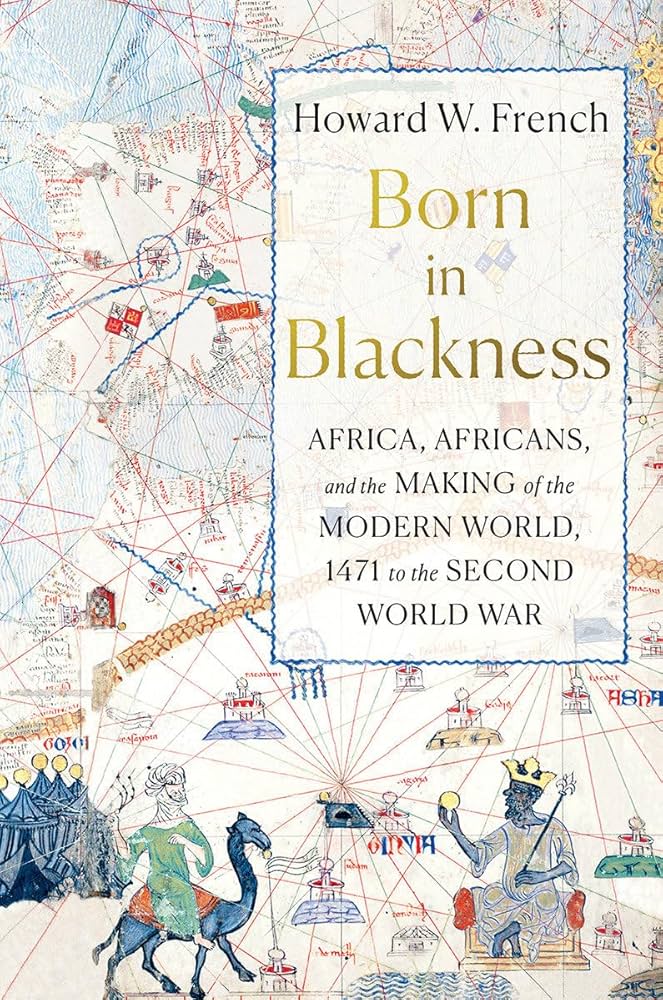
I’m a student of Africa and its history. Because of all the work our foundation does with partners on the continent, over the years I’ve set out to learn from African experts, read lots of books about it, and studied many countries there while on visits for the foundation. But I now see Africa even more clearly thanks to Howard French’s new book, Born in Blackness. It’s a well written and thoroughly researched book that challenges the standard Western accounts of the continent.
French, whose family comes from Africa, has been a professor in Côte D’Ivoire and the United States, and an Africa correspondent for The New York Times. He gives readers a new perspective on the African continent as well as a new perspective on this continent.
French takes a hard look at the idea that Europe’s “Age of Discovery” was the natural outgrowth of its wealth, power, and technological achievements. In fact, he argues, at the dawn of the 16th century the warring and fractious nations of Europe were less powerful and innovative than other regions. The continent produced little of value to potential trading partners. Its voyages of discovery would not even have been possible without the profits that Europe’s royals earned from African gold.
He writes: “The gigantic boost that [this gold] provided the [Portuguese] crown … made it possible for Lisbon to keep pace with Spain in their headlong course into ocean faring, discovery, conquest, crusading, and intercontinental trade.”
Another idea he sets out to correct is that Africa was stateless and primitive before the Europeans arrived. In reality, he explains, various African kingdoms had established city-states that rivaled Europe’s in terms of political organization, military power, commerce, art, and exploration.
And at least one such kingdom, in present-day Mali, had much more wealth than any royal family in Europe. When the Malian Emperor Mansa Musa and his 60,000-person entourage crossed the African continent in 1342, they brought as much as 18 tons of pure gold along to use in trade and as gifts. Unfortunately, reports of Musa’s wealth eventually arrived in European capitals, which helped trigger Europeans’ pursuit of Africa’s riches.
French also argues against the idea that labor by enslaved people from Africa made only a marginal contribution to the rise of the West. For example, he writes, “The value derived from the trade and ownership of slaves in America alone [was] greater than that of all of the country’s factories, railroads, and canals combined.” And more generally: “Without Africa, and the slave plantation agriculture of the Caribbean that derived from it, there would never have been the kind of explosion of wealth that the West enjoyed … nor such early or rapid industrialization.”
It's a sign of a good book when you finish it wanting to know more about one of its topics, and that was certainly true for me with Born in Blackness. I’m trying to learn more about how the value of goods like sugar and cotton has changed over time—French quotes some sources that say profits on these goods remained high throughout much of the history he covers, but it seems like competition should have driven profits down, since both crops grow in a lot of places.
But that’s a rabbit hole I’m happy to go down. It’s a compliment, not a criticism, that French left me more curious. If you’re interested in learning more about the history of Africa, its central role in the world, and the ways in which both have been misunderstood in the West, I highly recommend Born in Blackness.
icon_Share Share Get my newsletter Under the sea
Growing older with Remarkably Bright Creatures
Shelby Van Pelt’s novel was the perfect way to start my next decade of life.
Bill profile picture By Bill Gates published on Wednesday, Nov 26, 2025 Books All book reviews Iturned 70 years old last month. I don’t feel like it, though. I still have a ton of energy, and I have no plans to retire. But somehow, I have officially reached an age my younger self would have called “old.” It’s hard to wrap my head around.
Fortunately, I recently read Remarkably Bright Creatures, a terrific novel that helped me make a bit more sense out of aging. Shelby Van Pelt released her debut novel a couple years ago. It was a huge hit, and I think I might be one of the last people to read it—but I’m glad I waited until now.
Tova, the main character, is also 70, and she feels every single one of those years. Her life hasn’t been easy. Tova’s son is presumed dead after he disappeared when he was a teenager, and her husband died from cancer five years earlier. To pass the time, she works night shifts cleaning the local aquarium, which is where she meets Marcellus, an elderly giant Pacific octopus who is nearing the end of his life.
Marcellus is a fascinating character. Octopuses are some of the smartest animals in the world, and although Marcellus can’t speak, he is super observant. Van Pelt cleverly includes chapters from his perspective, so you get to learn about how he sees the world. He considers Tova a friend after she rescues him after a late-night excursion from his tank goes dangerously wrong. I don’t want to spoil the ending, but Marcellus’s power of observation ends up changing the lives of many of the books’ characters.
Tova gets a much-needed sense of fulfillment from caring for Marcellus and the aquarium. She struggles with purpose throughout the book. Her friends are motivated by their grandchildren, but without her husband and son, Tova feels aimless and alone (even though the reader knows that she has plenty of people in her life who love her—including Ethan, the owner of the local grocery store). Early in the book, she feels so lost that she considers moving away from her hometown and into a senior living community.
Tova’s struggle is something I’ve spent a lot of time thinking about, because I worry that we might soon see more people feeling like her. As life expectancies go up, many people are living for years and even decades after they stop working. That sounds like a luxury, and it is in a lot of ways—but it is also a lot of time to fill. The decline of third places like churches and libraries makes it harder than ever to find connections that keep the days interesting. Fewer families are having children, which means that fewer older people are becoming grandparents. And while part-time work can help give life meaning, not everyone is physically capable of working.
“Tova has always felt more than a bit of empathy for the sharks, with their never-ending laps around the tank. She understands what it means to never be able to stop moving, lest you find yourself unable to breathe,” Van Pelt writes. Her message is clear: People need a reason to get out of bed in the morning. For many, it’s hard to transition from a lifetime of working to retirement. So, what can we do to help older people find purpose? And how can we prepare for a potential future where technological advances mean all of us have less work to fill our days?
Remarkably Bright Creatures doesn’t try to answer those questions, but Tova’s story really makes you think about how people find meaning in life. Her story is mirrored by Cameron’s, a young man who struggles to find his own purpose and ends up working with Tova at the aquarium. Although their lives couldn’t be more different, I loved seeing how Tova and Cameron help each other find reasons to get out of bed over the course of the story (with help from Marcellus the octopus).
I think anyone who enjoys fiction would enjoy this book, but it’s a must-read for people who grew up in Western Washington like I did. The novel takes place in Sowell Bay, a fictional coastal town that will feel familiar to anyone who has spent time around Puget Sound. Van Pelt captures the specific feeling of weathered charm you get when you visit places like Hood Canal or Anacortes.
I usually read non-fiction books, but Remarkably Bright Creatures gave me exactly what I want whenever I pick up a novel. It transported me to a different world, and it illuminated something new for me—in this case, about relationships and getting older. Reading Tova and Marcellus’s story was the perfect way to start my next decade of life.
icon_Share Share Get my newsletter Climate matters
I loved this clear-eyed guide to global warming Hannah Ritchie’s concise, reader-friendly Clearing the Air.
Bill profile picture By Bill Gates published on Wednesday, Nov 26, 2025 Books All book reviews Climate change is one of the most important issues of our time and is causing enormous suffering, especially for the world’s poorest people. That makes it especially important for our conversations about climate to be grounded in facts. A few months ago I read a book that does an amazing job of that.
It's called Clearing the Air, and it’s the second book by data scientist Dr. Hannah Ritchie, a senior researcher at Our World in Data, an online platform that uses data to create super-clear visuals about global trends. (The Gates Foundation is one of their funders.) I’ve known and admired Hannah for several years. I learned about her work by reading her excellent first book, Not the End of the World, which argues that the global picture—in terms of health, poverty, the environment, and other measures—is a lot brighter than many people think. I liked it so much that I asked her to record an episode of my podcast with me.
Hannah brings the same spirit to Clearing the Air, which came out this year in the U.K. and will be published in the U.S. next March. She organizes it around fifty questions, like Isn’t nuclear power dangerous?, Is there any hope of low-carbon aviation and shipping?, and Aren’t renewables too expensive?
Her answers are a model of science writing for a general audience. She avoids jargon and keeps things concise—most chapters are only a couple of pages long, and each one starts with a summary that’s only one or two sentences long. For example, here’s her brief answer to a question about whether electric cars are too expensive for the average driver: “Electric cars are much cheaper to run, and will soon be just as cheap to buy upfront.” Over the next few pages, she explains why that’s true, but that single sentence is a memorable way to sum it all up.
She opens the book with a sharp question: Isn’t it too late? Aren’t we heading for a 5 or 6°C warmer world?. Here’s her short answer: “Every tenth of a degree matters. There’s no point at which it’s too late to limit warming and reduce damage from climate change.” After expanding on that answer, she turns to a bulleted list of three tips for talking about climate in a more helpful way.
First, she says, “be honest about where we’re heading…the 1.5°C target is dead.” Second, “don’t throw in the towel… Our 1.5°C and 2°C targets are not cliffs or thresholds.… Stop obsessing over arbitrary targets and focus on how you can help to reduce our carbon emissions as quickly as possible.” Finally, she suggests, “watch out for headlines based on worst-case scenarios. … Knowing the impacts of these extreme cases is useful for scientists, but not for policymakers or the public, who assume that this is the most likely outcome.”
One of the reasons we’re probably not headed for a worst-case scenario is that the energy transition is moving remarkably quickly in many areas. Hannah shows that solar and wind are scaling faster than any other energy source in history. In a single year, China built enough solar and wind capacity to power the entire United Kingdom, and half of the cars sold there are now electric.
Those are reasons to be optimistic, but not excuses to be complacent. We need to get renewables out there even faster, and we need to keep working on new breakthroughs like low-emissions steel, cement, and aviation fuel. These would be necessary even if there weren’t also the possibility that the climate will hit a tipping point and start warming faster than scientists are predicting now. Hannah has excellent chapters on each of those areas, and many others.
If I could add a 51st question to Hannah’s list, it would be: “Aren’t higher temperatures the biggest threat to mankind?” I’d love to hear her answer. Here’s mine: “Higher temperatures cause serious problems, especially in places with a lot of poverty and disease. The solution is to reduce emissions and also make sure people aren’t sick and poor.” I’m fortunate to be able to help on both fronts: lowering emissions by investing billions in clean-energy innovations, and fighting disease and poverty by giving away all my wealth through the Gates Foundation.
What I appreciate the most about Hannah is that she’s realistic about trade-offs and relentlessly focused on solving problems. As she writes toward the end of Clearing the Air, “The solutions we have today are as bad as they’ll ever be, and that’s a good thing.” They will only get better from here. That’s as true for vaccines and climate-smart seeds as it is for clean energy.
If you want a book that explains the climate challenge without doom or denial, Clearing the Air is a must-read. It’s a hopeful reminder that while the problem is enormous, the progress is real.
icon_Share Share Get my newsletter Diller instinct
The man who built modern media Barry Diller’s memoir is a candid playbook for creativity and competition in business.
Bill profile picture By Bill Gates published on Wednesday, Nov 26, 2025 Books All book reviews If you don’t know Barry Diller’s name, you definitely know his work.
He invented the made-for-TV movie and the TV miniseries. He greenlit Raiders of the Lost Ark, An Officer and a Gentleman, Grease, Saturday Night Fever, Terms of Endearment, and the Star Trek movies. He created the Fox television network and helped bring the world The Simpsons. He turned QVC into a home shopping behemoth. He assembled a digital empire that built or grew Expedia, Match.com, Ticketmaster, Vimeo, and many more companies now part of everyday online life.
And that’s just scratching the surface.
I’m lucky to call Barry a friend, and I thought I knew his story. But his new memoir Who Knew still managed to surprise and teach me a lot about him, his career, and the many industries he’s transformed.
The book opens with Barry’s complicated childhood in Beverly Hills. From the outside, his family life looked idyllic. But his brother struggled with addiction; his parents, though loving, were often emotionally distant and preoccupied. Meanwhile, Barry was grappling with his sexuality in an age when being gay meant living in constant fear of exposure.
This part of Who Knew is raw and honest in a way most business memoirs usually aren’t. But Barry’s early years are key to understanding not just who he became as a person but also how he succeeded professionally. Reading the book, you can see how the same coping mechanisms he developed as a kid—learning to read people, defuse tension, compartmentalize, adapt—evolved into business instincts later on.
After barely graduating high school, Barry started in the mailroom of William Morris, a talent agency, at 19. Most people trying to break into Hollywood treat the mailroom as a stepping stone. The goal is to get out fast, become someone’s assistant, then get promoted to agent yourself. But Barry spent years there by choice, reading every contract and deal memo in the agency’s history. (His obsessive self-education reminded me of my own approach to learning.)
By the time he joined ABC at 23, he knew more about how the entertainment industry actually worked—the deal structures, the power dynamics, who mattered and why—than executives twice his age. That foundation let him revolutionize an industry in ways you can only do when you truly understand it.
At ABC, Barry came up with the made-for-TV movie: 90-minute films produced specifically for television, with different stories and casts each week. Within a year, ABC was producing 75 original movies annually. By 27, Barry was the youngest vice president in network television history. Then he created the miniseries.
Five years later, he was named chairman of Paramount Pictures, which had fallen to fifth place among the major movie studios. Barry rebuilt it into the number one studio by focusing on ideas first, not pre-packaged deals that came with the stars, directors, and writers already attached. He built a team of young executives and put them through what he called “creative conflict”: exhausting late-night sessions where his team would tear ideas apart to find their essence. Only if an idea survived that process would they develop it and then attach the right talent.
After leaving Paramount, Barry joined 20th Century Fox as chairman. But what he really wanted to do at Fox was create something that didn’t exist yet: a fourth national network to rival ABC, CBS, and NBC. That’s probably what surprised me most in the book—learning that Fox Broadcasting was Barry’s idea, not Rupert Murdoch’s. Barry had been pitching a fourth network for nearly a decade, even though conventional wisdom said that America could only support three networks. But Barry thought they’d become homogenous and identified an opening for something new. Eventually, he got Murdoch to agree.
That pattern shows up throughout the book. Barry is able to see opportunities that are invisible to everyone else and sound crazy until they don’t. When he left Fox at its peak to run QVC, people were baffled, including me. In reality, Barry had recognized that the future of commerce was hiding in plain sight, on a home shopping channel, where phone calls spiked in real-time as products were pitched on TV. This epiphany about interactivity—screens as two-way, not just passive—helped Barry do super well in the digital era.
Barry was early to see the internet’s potential and willing to bet on it when others weren’t. In 2001, he was in the process of buying Expedia from Microsoft when 9/11 happened and air travel grounded to a halt. He had an out clause but decided to go through with the acquisition anyway, betting that travel would come back. It did, and Expedia became one of the first major successes in what would become IAC: the unlikely conglomerate of 150+ internet businesses Barry assembled over the next two decades.
I’ve always wondered why one studio succeeds while another fails, and how revolutionary ideas get greenlit when conventional wisdom says they’re impossible. Barry provides a lot of insight, especially about media and entertainment, that I didn’t know before. He’s also candid about his failures: the disastrous stint running ABC’s prime-time programming, getting outmaneuvered in bidding wars, trusting the wrong people. I like that Barry doesn’t gloss over mistakes or reframe them as “learning experiences.” He just tells you he screwed up.
In his book, Barry attributes much of his success to luck and timing. But there’s a difference between being in the right place at the right time and knowing what to do once you’re there.
Who Knew? Barry did. He just had to wait for everyone else to catch up.
Source from: https://www.gatesnotes.com/books/all-book-reviews/reader/who-knew